

The Challenge: Rebuilding the Core While the Business Kept Moving
Following the change in ownership of its Singapore food retail business in 2025, Cold Storage Singapore (CSS) needed to establish an independent core retail system within a compressed timeframe.
This was more than a technology replacement.
CSS operates multiple brands and formats, including Cold Storage, CS Fresh, Giant and Jasons Deli, each with different assortments, pricing strategies, replenishment requirements and store operating models.
The new environment therefore needed to standardise core processes and data while preserving the flexibility required by different brands and formats. It also needed to enable faster responses to local business needs and support future expansion.
| Why Dmall
CSS evaluated different technology options before selecting Dmall.
One key consideration was Dmall’s focus on retail operations. DMALL OS connects merchandise, supply chain, store operations, POS and business intelligence across an end-to-end retail flow, rather than treating them as isolated functions.
Before the project began, CSS management visited Dmall deployments, including 7-Eleven South China, to see the system in a live, large-scale retail environment.
For CSS, product fit mattered, but so did localisation, delivery speed and the ability to work closely with business teams.
Vanessa Tung, Category Manager – Grocery, said:
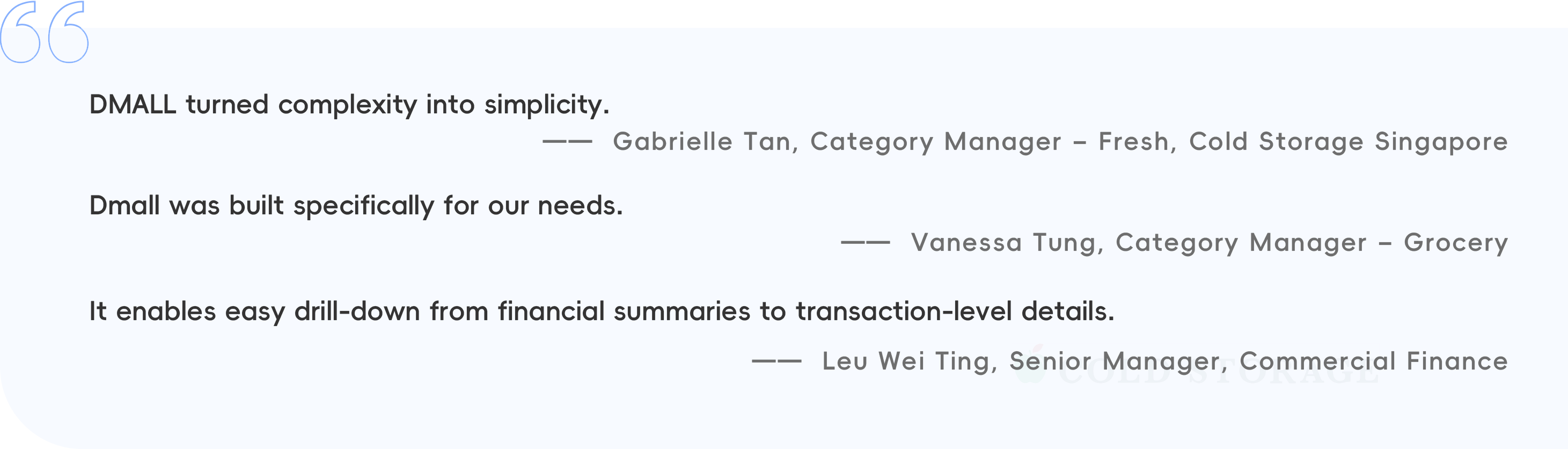
“Dmall was built specifically for our needs, providing a comprehensive platform for master data, billing, reports, and more.”
Lin Zhengliang, Head, Process & Systems, highlighted the implementation approach:
“Their solutions are always designed with end-to-end thinking, helping ensure a smooth transition and minimizing the risk of downstream issues.”
| Turning Business Rules into Working Systems
Built on the cloud-native DMALL OS, the project covered eight core business areas and 117 system modules, spanning merchandise management, supply chain, store operations, rebates, business-finance integration, shelf-label management, promotions and business intelligence.
The work went beyond configuring software. Dmall and CSS teams worked through the retail processes behind the systems: how items are created, purchase orders are managed, inventory moves, prices and promotions reach stores, and transactions flow through reconciliation into finance.
The objective was not to force every brand into the same operating model, but to establish common standards while preserving the differences that mattered to each business.
For Gabrielle Tan, Category Manager – Fresh, the change was clear:
“DMALL turned complexity into simplicity. Promotions that once meant manual Excel and system time-limit uploads are now immediate and seamless; margins and costs that were once in multiple modules are now visible at a glance. Decisions, including range rationalisation and trade planning, are made faster and sharper.”
Keith Lee Yong Keat, Manager, Business Administration, also highlighted simpler workflows, with multiple data-maintenance points consolidated into integrated modules, supported by clearer approval flows and task prompts.
| 87-Store Cutover Completed in 17 Days
The full store rollout began in March 2026.
The challenge was not simply the number of stores. Different formats, assortments, inventory profiles and external system connections meant that each rollout wave could surface different issues.
The programme therefore followed a rapid cycle of cutover, feedback and adjustment. Issues identified in one wave were assessed and addressed before the next stores went live.
Solution design, development, integration and testing ran in parallel, supported by on-site and remote teams. Multiple rounds of business testing, integration testing, stress testing and cutover rehearsals were completed before the full rollout.
The key test was whether the entire retail flow worked end to end: prices reaching the POS correctly, promotions executing as intended, transaction data flowing into inventory and finance, and external systems continuing to exchange data reliably.
The 87-store cutover was completed in 17 days, with no major system incidents affecting ongoing operations.
| What Changed After Go-Live
Longer-term business KPIs are still being tracked, but CSS teams are already seeing changes in how data, decisions and day-to-day work move across the business.
Less Manual Work, Better Inventory Visibility
Ness Marcelino, Manager, IT Business Partner & Projects, said:
“Dmall provides an end-to-end ERP-to-POS solution that centrally manages product, pricing, promotion, sales, and inventory data.”
Reducing manual handoffs between systems helps minimise errors, improve promotion consistency across stores and provide real-time inventory visibility.
Greater Financial Traceability
Finance teams now have clearer end-to-end visibility from SKU setup and purchasing through goods receipt, sales, payment collection and Dynamics 365 accounting entries.
As Leu Wei Ting, Senior Manager, Commercial Finance, put it:
“Dmall enables easy drill-down from financial summaries to transaction-level details, including SKU details, margins, inventory, rebates, promotions and payment types.”
This gives the team a clearer view of not only what changed in the numbers, but also where those changes came from.
Better Visibility Across Store Operations
Alimah Bte Mohd. Yusof, Senior Manager, Operations Audit, Store Operations, said:
“DMALL has transformed our operations by streamlining processes, providing real-time inventory visibility, and enhancing overall productivity.”
Mobile-enabled tools allow store teams to manage tasks and inventory more directly, with greater accountability, while giving management better visibility across store operations.
| What Comes Next
The 87-store rollout marked the first phase.
Dmall is now supporting CSS as the new system is extended to CS On The Go, its fuel and convenience retail business, where assortment, transaction patterns and replenishment requirements differ from those of traditional supermarkets.
AI is another area the two companies are exploring.
The next step is to explore how connected retail data can move from analysis into operational decisions, including demand forecasting, replenishment and store execution.
As Lin Zhengliang said:
“This deployment represents just the first phase. We look forward to upcoming releases, including enhanced AI-driven capabilities and automated workflow improvements.”
The first phase established a more connected core retail environment, creating a foundation for new formats and, over time, more AI-driven retail operations.