

Zhongbai Group: How a Legacy State-Owned Enterprise Reinvented Its “Value Engine” Through Supply Chain Transformation
| Client Overview
Zhongbai Holdings Group Co., Ltd. (stock code: 000759) is both a long-standing leader and a forward-thinking innovator in China's retail sector. Originating from Jianghan Road Central Department Store in 1937, Zhongbai Group has evolved over 80 years into a leading retail enterprise with a core presence in Hubei province and a significant footprint across Central China. As of year-end 2024, the Group operates over 1,600 locations, generating more than ¥22 billion in annual sales. It ranked 9th among China's Top 100 Supermarkets in 2024 and is recognized by the Ministry of Commerce as a key national commercial enterprise.
| Collaboration Background
Deeply rooted in its mission to serve local communities, Zhongbai Group has consistently invested in digital intelligence and smart logistics to fortify its supply chain and regional market integration. To accelerate this evolution, Zhongbai partnered with Dmall, setting an ambitious goal to achieve a quantum leap in holistic operational efficiency. The primary objectives were to break down data silos, re-engineer workflows, optimize resource allocation, accelerate inventory turnover, foster seamless supplier partnerships, and enable data-driven decision-making.
| Co-Creation Journey
1、Digital Vendor Management: Optimizing Resource Allocation
Joint Venture Vendor Management: Resource positions are systematically classified and digitally bundled according to key criteria such as scarcity and location. Suppliers bid online, ensuring optimal utilization and maximization of resource value.
Direct-Purchase Procurement: Vendor announcements are published via a collaborative platform, with results posted online. Leveraging digital planogram capabilities ensures strict oversight and effective execution of vendor agreements.
Fresh Produce Pricing: A centralized online bidding system allows suppliers to compete, with contracts awarded to the lowest bidder. Weekly data updates maintain transparency and precise price control for fresh categories, which are prone to frequent price fluctuations and complex supplier management.
2、E-Contracts: Streamlining Retail-Supplier Collaboration
By digitizing negotiation forms, implementing online approval workflows, and utilizing automated digital signatures, the contract lifecycle was dramatically shortened. This system provides a secure, cloud-based archive and a complete audit trail of all operations, significantly enhancing risk management and compliance while building a more efficient and trusted partnership with suppliers.
3、Merchandise Management: Accelerating Inventory Turnover
Category Tiering: Products were selected based on shelf resources, category breadth, and business value, with over 15,000 SKUs tiered for management.
Planogram Execution & Verification: Through digital mapping, precise task assignment, and intelligent verification, the full “planning–execution–inspection” workflow was streamlined, ensuring planogram strategies were accurately reflected on shelves and execution rates improved.
Dynamic Adjustment Mechanisms: New, fast-moving, and seasonal items were subject to tiered locking codes and periodic updates to ensure product mix adaptability to market demand.
Automated Replenishment System: Multi-dimensional data, including historical sales, seasonal trends, holidays, and promotions was used to forecast demand and generate replenishment suggestions automatically. Multi-level interception rules filtered anomalies, enhancing replenishment accuracy.
4、Digitized In-Store Operations: Boosting Efficiency
Core store-level processes, including ordering, receiving, returns, inter-store transfers, and inventory counts, were fully digitized. Frontline associates can now manage these tasks efficiently using mobile devices, enabling a new standard of streamlined, data-driven, and intelligent store operations.
| Co-Creation Results
1. Optimized Vendor Performance
The digital vendor management system generated over ¥28.6 million in incremental revenue, effectively driving the preservation and appreciation of state-owned assets.
2. Enhanced Collaboration Efficiency
The e-contracting system was successfully adopted across five major business units (Grocery, Fresh, Innovation, E-commerce, and Private Label), with over 1,000 suppliers registered and onboarded. This has forged a new model for supplier partnerships built on transparency, trust, and efficiency.
3. Accelerated Inventory & Sales Velocity (Data from 2024, post-implementation vs. prior period)
Inventory turnover days decreased by 9 days.
The sell-through rate increased by 6.96%.
Product efficiency increased by ¥31 in sales per item. This marked a significant improvement in capital efficiency and a substantial optimization of the product assortment.
4. Intelligent Store Operations
The digitization of in-store workflows has directly led to higher operational efficiency, reduced labor costs, and improved management precision, all while empowering frontline staff by reducing their administrative burden.
| Conclusion
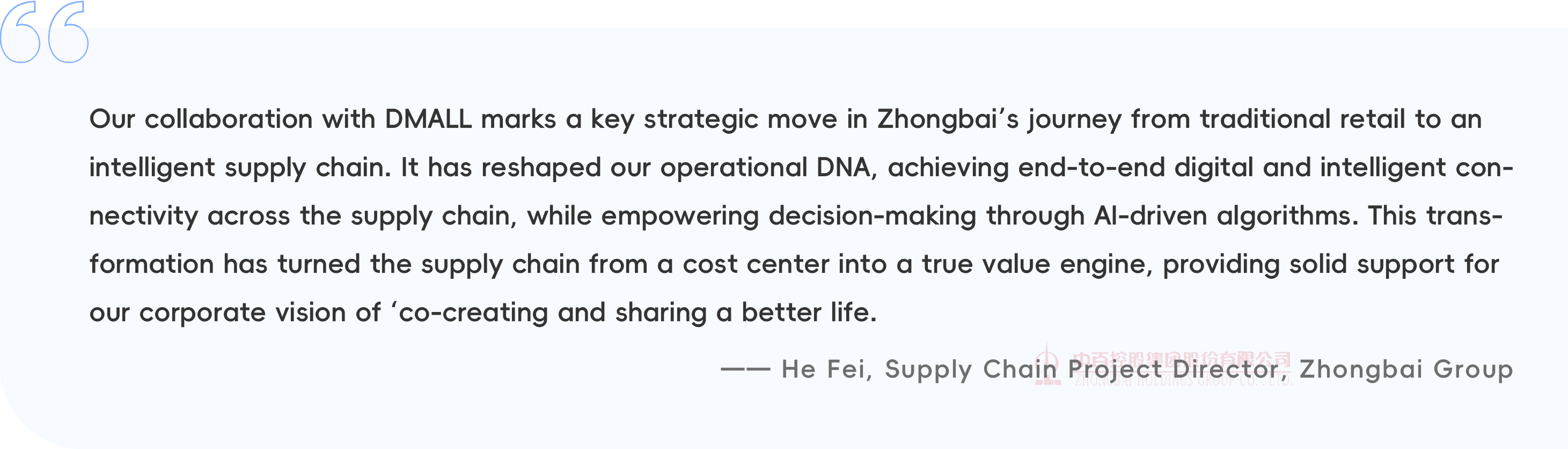
The digital transformation of Zhongbai Group proves that a legacy enterprise is not an "elephant that can't dance." By merging its deep-seated supply chain expertise with cutting-edge digital intelligence, the company has unlocked a powerful, ecosystem-level capability poised to reshape the retail landscape.
*Data based on actual results reported by Dmall clients.